
AI Readiness Assessment: Is Your Workforce Ready?
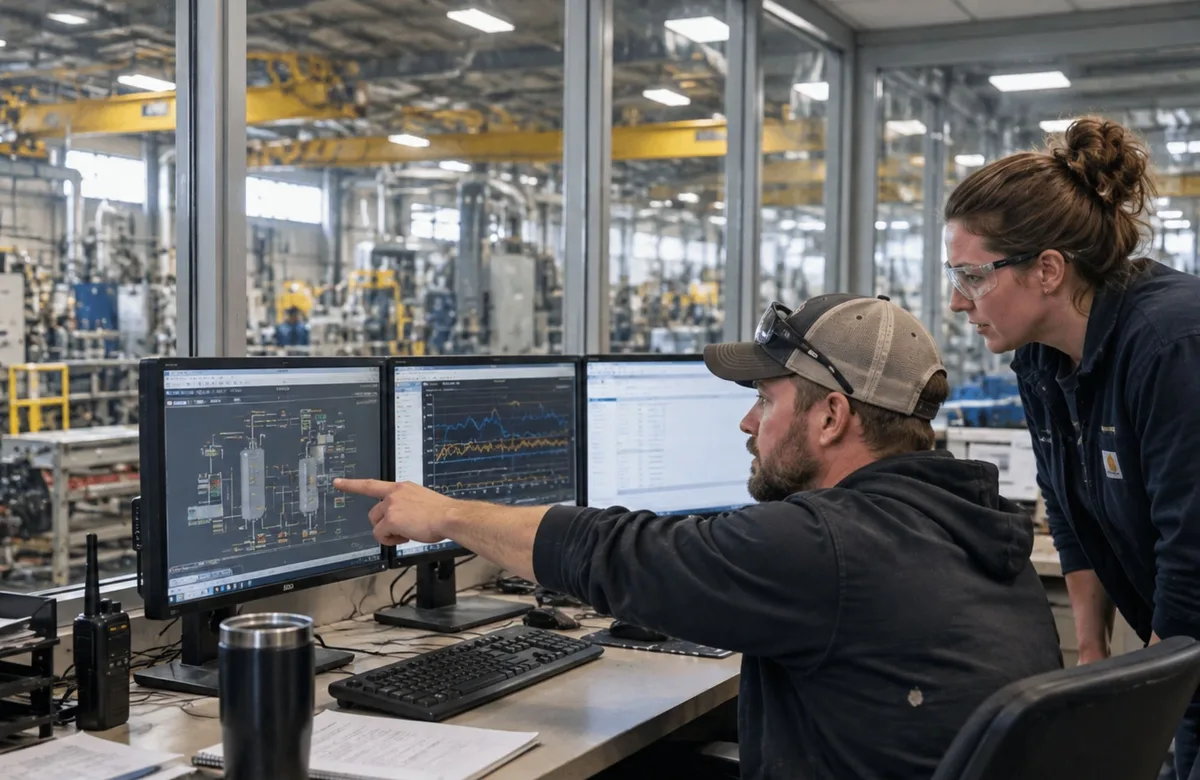
Adopting AI in manufacturing requires more than the right technology. Employees using AI-supported workflows also need the technical skills, reliable data, and established procedures to evaluate AI-generated recommendations and act on them safely.
This 25-question AI readiness assessment helps Operations VPs and L&D Directors identify gaps across four areas: data, workforce, processes, and technology. Use your results to prioritize improvements, identify workforce training needs, and evaluate whether your organization has the capabilities required for its planned AI applications.
The assessment also provides a starting point for aligning AI initiatives with operational goals, such as reducing unplanned downtime and improving equipment reliability.
What Is an AI Readiness Assessment?
An AI readiness assessment evaluates whether your organization has the data, workforce skills, processes, and technology needed to implement AI effectively. It helps identify capability gaps and prioritize improvements before investing in new AI applications.
In manufacturing, adopting AI requires more than purchasing software. Your technicians must be able to verify AI-generated recommendations and follow established troubleshooting and safety procedures. For example, a predictive maintenance system may flag unusual motor vibration, but a technician still needs to assess the equipment and determine the appropriate response.
The Four Key Pillars of AI Readiness
| Readiness Area | What It Evaluates | Why It Matters |
|---|---|---|
| Data readiness | Data quality, accessibility, and security | Supports reliable analysis |
| Workforce readiness | Technical skills, AI literacy, and training | Helps employees use AI outputs effectively |
| Process readiness | Governance, workflows, and accountability | Establishes clear responsibilities and oversight |
| Technology readiness | Infrastructure, connectivity, and system integration | Determines whether existing systems can support planned AI applications |
Assessing each pillar helps you identify gaps and prioritize the improvements needed for your AI goals.
For organizations addressing technical skill gaps, ITC Learning’s foundational skills training can help employees strengthen essential workplace and technical knowledge.
Why AI Readiness Matters to Operations and L&D Leaders
Investing in AI does not automatically improve plant performance. If technicians lack the skills to investigate equipment issues or employees cannot integrate AI outputs into existing workflows, the technology may not deliver the expected operational benefits.
An AI readiness assessment helps you identify these gaps before they affect implementation. The findings can guide training priorities, helping your team focus on the technical skills that support faster fault diagnosis, shorter technician ramp time, and more effective maintenance decisions.
Readiness also affects how you allocate resources. Identifying weaknesses early can help you avoid investing in AI applications before your workforce, processes, and infrastructure are prepared to support them. Track outcomes such as unplanned downtime and maintenance response time after implementation to evaluate whether the changes are delivering value.
For practical manufacturing applications, read AI in Manufacturing: What Maintenance Teams Need to Know.
The 25-Question AI Readiness Assessment
Use the following assessment to review your plant’s current capabilities across four areas.
How to Score Each Question
Score each question from 0 to 4 based on the capabilities your organization can demonstrate. Use documented processes and actual practices to guide your rating.
| Score | Readiness Level |
|---|---|
| 0 | Not established |
| 1 | Limited capability |
| 2 | Partially established |
| 3 | Established and consistently used |
| 4 | Documented, measured, and regularly improved |
If a capability varies across departments or facilities, base your score on the scope of the AI application being assessed and document any significant gaps.
The maximum score is 100 points across all 25 questions. This assessment is a planning tool for identifying gaps and prioritizing improvements. Its scores and categories have not been validated as predictors of AI implementation success.
Part 1: Data Readiness (6 Questions)
AI systems require accurate, accessible, and relevant operational information. Weak data foundations can limit the usefulness of AI models, regardless of their technical capabilities.
Evaluate your organization’s data readiness.
- Does your plant collect the operational data required for its planned AI applications?
- Are equipment records, sensor readings, and maintenance histories accurate and current?
- Can employees retrieve the operational data they need from existing systems without significant manual work?
- Are data ownership and data quality responsibilities clearly assigned?
- Are procedures in place to protect sensitive operational and customer data from unauthorized access?
- Does the available data include enough detail and context for employees to evaluate AI-generated recommendations?
Maximum: 24 points
Low scores may reveal data silos, inconsistent maintenance records, or limited data integration. Recommended actions include improving documentation, standardizing asset records, and reviewing data quality before implementing AI.
Part 2: Workforce Readiness (7 Questions)
Assess whether your employees have the technical knowledge and AI-related skills needed to use AI recommendations effectively in industrial maintenance.
- Do employees understand the AI applications relevant to their responsibilities?
- Do maintenance technicians have the mechanical, electrical, and automation skills required for their equipment?
- Can technicians interpret equipment trends, sensor readings, and diagnostic alerts?
- Can employees verify AI recommendations through established troubleshooting methods?
- Do teams understand when human review and escalation are required?
- Does your organization provide structured technical training and ongoing learning opportunities?
- Are supervisors and employees prepared to adapt to AI-supported workflows?
Maximum: 28 points
Low scores may reveal gaps in AI literacy, technical troubleshooting, human oversight, or workforce training. Address the skills most relevant to your planned AI applications before expanding their use.
For examples of the technical skills maintenance technicians need, read AI for Maintenance Technicians: A Practical Guide.
Part 3: Process Readiness (6 Questions)
Assess whether your organization has the goals, workflows, governance, and accountability needed to integrate AI into its operations.
- Are your AI goals connected to specific operational or business goals?
- Is there executive sponsorship and a clear leadership vision for AI initiatives?
- Have teams identified how AI recommendations will fit into existing maintenance and production workflows?
- Are responsibilities for AI risk management and regulatory compliance clearly assigned?
- Does your AI governance plan specify human oversight, approval authority, and accountability?
- Have you established metrics for evaluating AI outcomes and business performance?
Maximum: 24 points
Low scores may reveal misaligned goals, unclear responsibilities, or workflows that are not prepared to support AI. Address these gaps by clarifying ownership, documenting procedures, and defining how AI-related decisions and outcomes will be evaluated.
Part 4: Technology Readiness (6 Questions)
Assess whether your plant’s infrastructure, systems, and technical support can meet the requirements of its planned AI applications.
- Can your current computing, storage, and network infrastructure support planned AI workloads?
- Can connected sensors and equipment transmit the data required by the planned AI application?
- Can existing software systems exchange data with the planned AI tools in compatible formats?
- Do AI systems and their data connections have technical security controls to protect against unauthorized access and cyber threats?
- Does your organization have qualified internal personnel or external support for implementation and maintenance?
- Can your infrastructure support expansion beyond an initial pilot?
Maximum: 24 points
Low scores may reveal limitations in computing capacity, system connectivity, integration, cybersecurity, or technical support. Identify which limitations could affect your intended AI applications and address them before expanding deployment.
Calculate Your AI Readiness Score
Add the points from all 25 questions.
| Assessment Area | Maximum Score |
|---|---|
| Data readiness | 24 |
| Workforce readiness | 28 |
| Process readiness | 24 |
| Technology readiness | 24 |
| Total | 100 |
What Your Score Means
Use your total score to see where your organization is prepared for AI and where it needs improvement. These score ranges are intended to guide planning. They have not been validated as measures of AI readiness or predictors of implementation success.
| Score | Planning Category | Recommended Next Step |
|---|---|---|
| 0-39 | Foundational | Identify the most significant gaps in data, workforce capabilities, processes, and infrastructure. |
| 40-59 | Developing | Prioritize critical gaps and determine what your organization needs to address before testing a specific AI application. |
| 60-79 | Progressing | Review a potential AI use case against its technical requirements, operational goals, and risk controls. |
| 80-100 | Well-established | Evaluate whether a specific AI application can be expanded safely based on demonstrated results and adequate safeguards. |
Review each readiness pillar separately to identify weaknesses that may be hidden by a high overall score. For example, strong technology capabilities cannot compensate for unreliable data, inadequate workforce skills, or unclear accountability.
Before testing or expanding an AI application, address critical gaps in safety, cybersecurity, data quality, and human oversight. Confirm that the organization has the capabilities and safeguards required for the specific application, regardless of its total score.
If workforce readiness is a major concern, explore ITC Learning’s AI readiness training for the skilled trades to identify relevant learning topics for your maintenance and operations teams.
Turn Your Results Into a Workforce Training Plan
Your assessment results can help you prioritize training based on the skills your workforce needs for its planned AI applications. Match each gap to the technical knowledge employees need to perform their jobs safely and effectively.
For example, technicians who struggle to interpret equipment readings may need training in instrumentation and condition monitoring. Those who have difficulty diagnosing electrical faults may benefit from instruction in motors, circuits, and electrical troubleshooting.
Use the table below to connect identified skill gaps with relevant training and measurable workplace outcomes.
| Workforce Skill Gap | Relevant Training | Measure of Progress |
|---|---|---|
| Electrical knowledge | Motors, circuits, and electrical troubleshooting | Troubleshooting time |
| Mechanical knowledge | Bearings, lubrication, and power transmission | Repeat equipment failures |
| Data interpretation | Sensors, instrumentation, and condition monitoring | Accuracy of alert verification |
| Automation knowledge | PLCs and industrial controls | Fault diagnosis time |
| Troubleshooting methods | Structured diagnostic techniques | Maintenance response time |
| Technical fundamentals | Foundational industrial training | Time to required proficiency |
ITC Learning’s foundational skills training can support employees who need to strengthen their technical knowledge before taking on more advanced training.
Measure Business Outcomes After AI Implementation
Your AI investment needs to address a defined operational problem. Before implementation, record how the targeted equipment or team performs. Once the new tools and training are in place, compare performance with that baseline.
For a predictive maintenance project, you might examine unplanned downtime, repeat equipment failures, and the time technicians need to diagnose faults. If the project involves AI-assisted troubleshooting, check whether employees can verify recommendations accurately and follow the correct procedures.
Training data matters, too. Track how long technicians take to reach the required level of proficiency and whether they can demonstrate the skills needed on the job.
Changes in these measures do not automatically prove that AI caused the improvement. Equipment condition, production demand, and maintenance practices can also affect results. Use the evidence to decide whether to adjust the implementation, invest in further training, or expand the project.
For Individual Technicians: Build Skills for AI-Enabled Maintenance
AI-supported maintenance still depends on technicians who understand industrial equipment and can evaluate recommendations before acting on them. If you’re developing your career in maintenance, focus on strengthening the skills relevant to your role and the equipment you work with.
Key areas to develop include:
- Troubleshooting: Diagnose electrical and mechanical faults using established procedures.
- Instrumentation: Interpret sensor readings and recognize unusual equipment conditions.
- Industrial controls: Understand how PLCs and automated systems operate.
- Safe maintenance: Verify AI-generated recommendations before taking action.
Technical training and supervised workplace experience can help you build these capabilities. Depending on your experience and career goals, an apprenticeship or relevant industry certification may also support your development.
ITC Learning has supported more than 1 million learners through industrial skills training. Explore ITC Learning’s AI readiness courses to learn about training for AI-supported industrial workplaces.
Prepare Your Workforce for AI Adoption
For Operations and L&D leaders, the assessment provides a starting point for deciding which workforce capabilities need attention before expanding AI adoption. Your next steps should reflect the gaps that could affect your planned applications, from technical troubleshooting skills to employees’ ability to interpret AI recommendations.
ITC Learning helps manufacturers develop the technical foundations their teams need through industrial skills training, skills assessments, and flexible learning management system (LMS) delivery. Explore AI readiness training for your workforce or request a demo to discuss your organization’s training needs.
Why Organizations Choose ITC Learning
ITC Learning offers:
- 50+ years developing skilled-trades training
- 1M+ learners trained across technical and industrial skills
- 175+ courses and 450+ lessons covering electrical, mechanical, and other skilled-trades topics
- SCORM-compliant training that can be delivered through the ITC Learning LMS or an existing compatible learning management system
- Training available in English and Spanish
- Training that supports manufacturers, industrial employers, educational institutions, workforce development programs, apprenticeships, and CTE partnerships
Organizations can explore ITC Learning’s emerging technologies course library for training on data center systems and EV charging infrastructure. For AI-specific workforce training, explore AI Readiness for the Skilled Trades. Specific AI platform instruction and hands-on job qualification may require additional training.