
Data Center Technician Certification vs. Role-Based Training
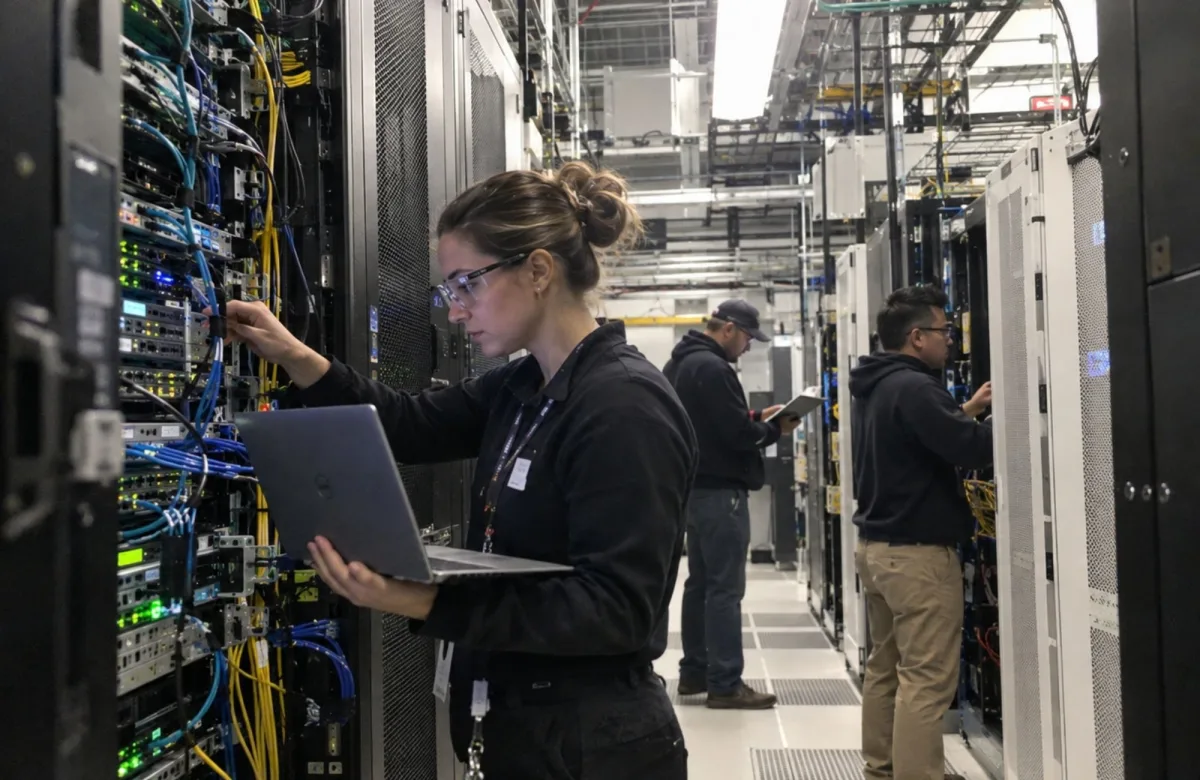
A data center technician certification can show that a technician has completed a defined program and demonstrated a baseline level of knowledge. It does not, on its own, prove that the technician is ready to operate, maintain, or troubleshoot the electrical, cooling, controls, and mechanical systems at your facility.
For facilities leaders, the better question is not simply, “Which certification should we require?” It is, “What does this person need to know for the systems and responsibilities assigned to the role?”
That is where role-based data center technician training becomes important. Organizations can build on an electrician’s, HVAC technician’s, controls technician’s, or maintenance professional’s existing trade knowledge while adding the mission-critical skills needed for data center operations.
Certification and Role-Based Training Solve Different Problems
Certifications and structured training pathways can complement each other, but they do different jobs.
A certification generally validates completion of a defined program and/or achievement against criteria established by the provider. It can be a good starting point for evaluating technicians, but employers should review the detailed exam topics and industry standards covered before making it a hiring requirement. A credential focused on data centre operations management may suit an operational leadership role, while a facilities technician needs deeper preparation in the systems they will maintain.
Role-based training starts from a different point. It asks what the employee will actually be responsible for.
For example, an electrician entering a critical facility may already understand three-phase power, protective devices, electrical diagrams, motors, and safe electrical work. The development gap may be understanding how utility service, switchgear, UPS systems, batteries, generators, transfer systems, PDUs, redundancy, and operating procedures interact around a critical load.
An HVAC technician may already understand refrigeration, pumps, chillers, airflow, bearings, and troubleshooting. The gap may be continuous cooling requirements, redundant cooling architectures, high-density loads, BMS monitoring, liquid cooling, and the consequences of taking equipment out of service when redundancy is already reduced.
Certification can help establish a baseline. Role-based training closes the gap between knowing a trade and applying that trade inside a mission-critical facility.
How Common Data Center Certifications Compare With Role-Based Training
Facilities leaders should evaluate any credential according to its actual scope rather than assuming that “data center certification” means the same thing across programs.
| Option | Primary Audience | Main Focus | What It Covers | What It May Leave for the Employer to Address |
|---|---|---|---|---|
| CDCP – Certified Data Centre Professional | Data center, IT, facilities, and related professionals | Broad data center physical infrastructure | Power, cooling, security, cabling, fire protection, safety, efficiency, and operations concepts | Role-specific depth, facility procedures, equipment-specific qualification, supervised practice |
| CDCTP – Certified Data Centre Technician Professional | Personnel working in mission-critical facilities | Broad technician-level data center operations | Mission-critical operating environment, including power, cooling, IT, space, procedures, standards, and operational requirements | Employer-specific systems, work authorization, local procedures, task qualification, deeper craft development where needed |
| Cisco Data Center certifications | Network, systems, and data center IT professionals | IT infrastructure | Networking, compute, storage, automation, security, and related data center technologies | Facility electrical power, HVAC, pumps, generators, mechanical systems, and much of the MEP infrastructure |
| Vendor certifications | Technicians or engineers supporting a particular product or platform | Specific equipment or technology | Product configuration, operation, diagnostics, maintenance, or implementation within the vendor’s scope | Cross-system knowledge, other manufacturers’ equipment, overall facility infrastructure, site procedures |
| Role-based pathway | Electricians, HVAC technicians, controls technicians, maintenance personnel, critical-facilities technicians | Skills tied to job responsibilities | Trade fundamentals plus power, cooling, controls, monitoring, safety, maintenance, reliability, and mission-critical context according to role | Site-specific qualification, supervised practice, authorization, and employer procedures still remain necessary |
For example, EPI describes its Certified Data Centre Professional (CDCP®) as a two-day program covering key data center infrastructure components such as power, cooling, cabling, fire protection, safety, security, and operations. CNet’s Certified Data Centre Technician Professional (CDCTP®) is a five-day program intended for people working in mission-critical facilities and covers power, cooling, IT, space, operational procedures, standards, and routine monitoring.
The point is not that one option is universally better. The correct choice depends on the job.
Which Data Center Technician Certification Should Employers Require?
There is no single data center technician certification that every employer should require. The right credential depends on the systems a technician will work with, the trade knowledge they already have, and the responsibilities they will perform inside the facility.
A facilities director or MEP service manager should define the work first, then decide whether a certification, role-based training pathway, vendor credential, or combination of these best fits the position.
Before selecting training or certification, answer five questions:
-
What systems will this technician work around or maintain?
-
What trade knowledge should the technician already have?
-
What mission-critical knowledge is new to the role?
-
Which tasks require supervised practice or formal qualification?
-
How will the organization verify that the technician can perform the assigned work safely and correctly?
What Skilled-Trades Technicians Need to Add for Mission-Critical Work
A skilled electrician or HVAC technician does not become a beginner simply because they enter a data center.
Their existing craft knowledge is valuable. The development need is often context.
System Interdependencies
Technicians need to understand how key components interact across the power and cooling chains. For example, maintenance on power distribution equipment may affect a cooling unit and reduce the facility’s available cooling capacity. The risk depends on the current configuration, remaining capacity, and approved work procedure.
Training should connect individual equipment knowledge to these dependencies. That helps your technicians evaluate data center solutions in the context of the whole facility rather than treating each system as an isolated asset.
Redundancy and Current Configuration
Terms such as N, N+1, 2N, A/B paths, reserve capacity, and concurrent maintainability are not just design terminology.
They affect maintenance decisions.
Taking one component offline may be routine when full redundancy is available. The same action may carry much more operational risk if another component is already unavailable.
Procedure Discipline
Mission-critical facilities often use standard operating procedures, maintenance operating procedures, work authorization, change control, escalation procedures, and detailed logging.
Technical skill remains important, but the ability to follow approved procedures and understand the current configuration is equally important.
Cross-System Awareness
Electrical technicians need enough cooling and controls knowledge to recognize when their work affects another system. Mechanical technicians need enough electrical understanding to recognize power dependencies. Controls technicians need to understand what the equipment behind a BMS or DCIM point is actually doing.
That does not mean every technician needs to become a specialist in every discipline. It means the workforce needs enough shared understanding to operate safely around interconnected systems.
Six Role-Based Data Center Training Pathways
ITC Learning structures its data center curriculum around six workforce pathways rather than a single generic technician course. The pathways combine existing electrical, mechanical, HVAC, instrumentation, controls, safety, and foundational training with the new Data Centers & Critical Infrastructure curriculum.
1. Data Center Foundations: 17 Courses
The Data Center Foundations pathway provides broad preparation for employees, contractors, and new entrants who need to understand the major systems and operating expectations of a critical facility.
It combines data center fundamentals with electrical safety, lockout/tagout, personal protective equipment, procedures, workplace communication, logical thinking, and hand-tool knowledge.
This can be useful when an organization needs a common baseline before employees move into more specialized development.
2. Data Center Pre-Apprenticeship & Workforce: 32 Courses
The Data Center Pre-Apprenticeship & Workforce pathway is designed for people who need more preparation before entering a skilled-trades role.
Its 32 courses combine data center fundamentals with job readiness, applied math, safety, hand tools, electrical fundamentals, measurement, and introductory HVAC knowledge.
For workforce boards, educational institutions, apprenticeship programs, and employers building a talent pipeline, this creates a broader starting point than data center awareness alone.
3. Data Center Electrical / Critical Power Technician: 32 Courses
The Electrical / Critical Power Technician pathway is intended for electricians and electrical technicians responsible for critical power infrastructure.
Along with electrical fundamentals and troubleshooting, the pathway adds topics such as:
-
Electrical distribution and switching
-
Utility service and medium voltage
-
Power quality
-
UPS systems
-
Batteries and energy storage
-
Generators
-
Transfer systems
-
Critical-facility electrical safety
-
Redundancy and reliability
The goal is not to reteach an experienced electrician’s entire trade. It is to connect existing electrical capability to critical power systems and mission-critical operating practices.
4. Data Center Mechanical / Cooling Technician: 32 Courses
The Mechanical / Cooling Technician pathway serves HVAC and mechanical personnel responsible for the heat-removal systems that protect the critical load.
Its training spans HVAC and refrigeration, chillers and cooling systems, pumps, bearings, predictive maintenance, instrumentation, safety, and advanced cooling topics.
This becomes more important as facilities support higher-density computing and a mix of traditional air cooling and newer liquid-based systems.
5. Data Center Controls & Monitoring Technician: 27 Courses
Modern critical facilities depend heavily on instrumentation, building management systems, data center infrastructure management systems, alarms, trends, sensors, and automated controls.
The Controls & Monitoring Technician pathway includes 27 recommended courses covering:
-
Pressure, flow, and temperature measurement
-
Transmitters
-
Electronic controllers
-
Single- and multiple-loop control
-
Calibration
-
Distributed controls
-
PLC fundamentals
-
Ladder logic
-
BMS and DCIM monitoring
-
Electrical and lockout/tagout safety
The role requires more than knowing how to read a dashboard. Technicians need to understand what the monitored value represents, whether the reading makes sense, and when field verification or escalation is appropriate.
6. Data Center Critical Facilities Technician: 55 Courses
Some organizations use multi-craft critical-facilities technicians rather than narrowly separated electrical, mechanical, and controls roles.
For that workforce model, ITC’s Critical Facilities Technician pathway includes 55 recommended courses across critical power, cooling, electrical systems, mechanical systems, instrumentation, controls, safety, reliability, commissioning, monitoring, and incident response.
It is the broadest of the six pathways and is intended for roles that require technicians to understand how multiple facility systems work together.
Should Employers Assess Technicians Before Assigning Data Center Training?
Your technicians may already bring strong electrical, HVAC, mechanical, or controls experience into a data center role, but their knowledge gaps will not be the same.
One electrician may have years of switchgear and generator experience but limited exposure to UPS systems. Another may understand industrial motor controls well but need more development in medium-voltage systems or critical power architecture.
Assessing existing knowledge first helps you avoid unnecessary training, identify higher-priority gaps, and build a development path around the systems each technician will actually support.
ITC’s skills assessments can help organizations identify existing technical knowledge and potential gaps across electrical, mechanical, instrumentation, safety, and related areas.
A practical development process is:
Define the role → assess existing knowledge → identify gaps → assign targeted training → provide supervised practice → verify competency → authorize work according to company requirements.
Training completion is not the same as job qualification. Online learning platforms can deliver foundational knowledge, while supervised practice in person allows your organization to evaluate performance on actual equipment. Employers still control site-specific procedures, practical verification, and work authorization.
Where credentials are required, certification management should include tracking expiration dates, checking certification updates, and planning any required renewal activities. Keep those records alongside training and task-qualification records so supervisors can see what each technician is prepared and authorized to do.
Safety Training Must Match the Work Being Performed
Critical facilities contain electrical, mechanical, thermal, pressure, stored-energy, battery, chemical, and other hazards.
A data center credential should never be treated as blanket authorization to work on every system.
For servicing and maintenance covered by the standard, OSHA’s control of hazardous energy requirements require an energy-control program that includes procedures, employee training, and periodic inspections. OSHA also distinguishes between authorized employees who apply lockout/tagout and affected employees whose work is impacted by the servicing activity.
Employers must determine what safety training, qualification, PPE, procedures, supervision, and authorization apply to the actual tasks performed.
The workforce-development program should support those requirements, not replace them.
The 15 New Data Centers & Critical Infrastructure Courses Are In Development
Organizations do not need to postpone all data center workforce development until the new library arrives.
ITC Learning is developing 15 new Data Centers & Critical Infrastructure courses covering reliability and redundancy, critical power, cooling, life safety, monitoring, operations, electrical distribution, UPS systems, generators, advanced and liquid cooling, BMS/DCIM, commissioning, and incident response.
The electrical, HVAC, safety, controls, mechanical, instrumentation, and foundational courses used throughout the role-based pathways are available now.
That gives facilities leaders a practical sequencing option:
Start the technical foundation now. Add the purpose-built Data Centers & Critical Infrastructure courses as they become available.
An electrician can begin closing gaps in electrical troubleshooting, three-phase systems, diagrams, motors, instrumentation, and safety today. An HVAC technician can strengthen refrigeration, pumps, bearings, predictive maintenance, and instrumentation. Controls personnel can build measurement, calibration, controllers, PLC, and distributed-control knowledge.
The data center curriculum then adds the mission-critical context around those skills.
What Data Center Technician Qualifications Should Employers Require?
Employers should require a combination of trade competency, data center-specific knowledge, role-based technical training, safety qualifications, practical experience, and site-specific authorization. Certification can support that framework, but it should not replace hands-on competency or employer verification.
The exact requirements should follow the systems and responsibilities assigned to the role.
A practical framework is to require:
-
Trade competency appropriate to the position
-
Data center fundamentals covering mission-critical infrastructure and system dependencies
-
Role-specific technical training for electrical, cooling, controls, or multi-craft responsibilities
-
Relevant certification where it adds useful third-party validation
-
Safety training and qualification appropriate to the hazards and tasks
-
Site-specific procedures and system knowledge
-
Supervised practical experience
-
Documented competency or authorization before independent work where required
For some positions, CDCP, CDCTP, a vendor credential, or another industry certification may fit well within that framework. For others, existing trade credentials plus structured critical-facilities training may be more relevant.
The important point is that the credential should support the role rather than define it.
Why Organizations Choose ITC Learning
ITC Learning provides technical education that organizations can use as part of broader workforce-development, apprenticeship, onboarding, and technician-development programs.
-
50+ years developing skilled-trades training
-
1M+ learners trained
-
175+ courses · 450+ lessons
-
SCORM-compliant · Deliverable via ITC LMS or your existing platform
-
Available in English and Spanish
-
Supports manufacturers, industrial employers, educational institutions, workforce development programs, apprenticeships, and CTE partnerships
These resources can help facilities leaders build structured development paths while retaining control of hands-on training, site procedures, qualification, work authorization, and practical competency verification.
Talk to our team about data center pathways to discuss how electrical, mechanical, controls, safety, assessment, and data center training can be structured around your workforce.