
Instrumentation Training for Industrial Teams: Building I&C Technician Skills In-House
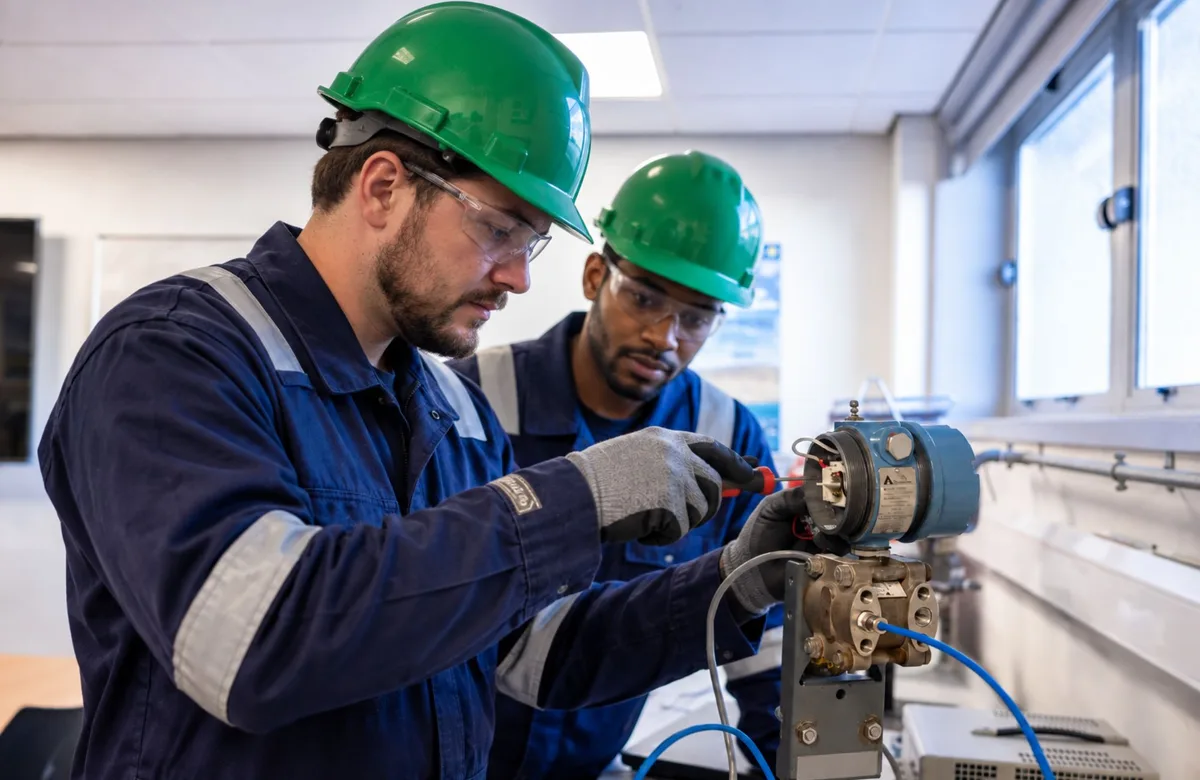
Instrumentation training helps develop the technical knowledge and, when paired with supervised practice, the practical skills technicians need to measure, monitor, and control industrial processes. A structured instrumentation and control (I&C) program combines instruction in sensors, transmitters, calibration, control loops, and troubleshooting with supervised equipment practice and documented competency checks.
For process-industry training leads, the priority is connecting those skills to plant responsibilities. Whether your organization runs an apprenticeship, supports workforce development, or upskills an existing maintenance team, training should prepare technicians to distinguish a measurement problem from a control-system or process problem before taking corrective action.
What Should Instrumentation Training Cover?
Industrial instrumentation measures process conditions such as pressure, temperature, flow, and level. Control systems use those measurements to help regulate operations. Your training program should teach the complete path from the process connection and sensing element through the transmitter, controller, and final control element, such as a control valve.
The following scope provides a starting point. Select the depth of instruction according to your equipment, process risks, and assigned work.
| Skill Area | Essential Knowledge | Practical Evidence to Assess |
|---|---|---|
| Electrical and electronic fundamentals | Voltage, current, resistance, signal circuits, and appropriate test instruments | Interpret a circuit and select the correct measurement function |
| Process measurement | Pressure, temperature, flow, and level; sensor selection and installation effects | Explain how a device measures the process variable and recognize application limitations |
| Instrument signals | 4–20 mA loops, signal scaling, and analog versus digital communication | Compare a known input with the expected signal and displayed value |
| Drawings and documentation | Piping and instrumentation diagrams (P&IDs), loop drawings, instrument tags, and data sheets | Trace an instrument signal through the relevant drawings |
| Calibration | Reference selection, test points, tolerances, and records | Compare an instrument with a suitable reference and document results |
| Control loops | Set point, measured process variable, controller output, and feedback | Explain how each component affects loop response |
| Control valves | Valve bodies, actuators, positioners, and failure behavior | Distinguish a command problem from a valve-response problem |
| Troubleshooting | Systematic testing of instruments, wiring, configuration, and process conditions | Identify an introduced fault and justify the diagnosis |
| Digital control systems | Smart transmitters, programmable logic controllers (PLCs), and distributed control systems (DCSs) | Interpret relevant device diagnostics and identify escalation needs |
ISA’s published control systems technician task outline includes calibration, maintenance, troubleshooting, commissioning, and documentation. Organizations can use it as a reference when reviewing curriculum coverage; it does not establish approval of a particular training program.
Keep the Instrumentation Focus Within the Maintenance Program
Electrical training and motor controls support I&C development, but they do not replace process-measurement instruction. An electrician who understands a motor starter may still need training in transmitter scaling, process connections, instrument calibration, and control-valve behavior.
Likewise, PLC programming alone does not teach technicians how to diagnose the field instruments supplying the controller. Connect these disciplines through plant examples while maintaining clear task boundaries for maintenance, operations, and engineering.
How to Structure an In-House I&C Training Program
Build the program around observable job tasks. “Understand pressure measurement” describes a topic. “Interpret the transmitter range, compare its output with a reference, and complete the calibration record” describes work your organization can evaluate.
1. Identify Equipment and Performance Gaps
Review instrument inventories, maintenance records, recurring failures, and supervisor observations. Include operations personnel: an apparent instrument fault can originate in changing process conditions or an installation problem.
Prioritize tasks according to failure consequences and frequency. A facility with repeated level-measurement problems needs a different starting point from one introducing smart pressure transmitters.
Combine a knowledge assessment with a practical baseline. A strong written score does not establish correct test-equipment use or sound troubleshooting judgment.
2. Sequence Instruction From Fundamentals to Application
Use a progression that reflects participants’ starting knowledge:
- Foundation: Applied math, electrical concepts, process variables, drawings, and safety.
- Measurement: Sensors, transmitters, signal types, ranges, and installation effects.
- Verification: Test instruments, calibration principles, and documentation.
- Control: Single-loop operation, control valves, and controller response.
- Diagnosis: Instrument, signal, configuration, and process faults.
- Specialization: Equipment-specific digital systems, analyzers, boiler controls, or other plant needs.
Assign advanced topics after technicians demonstrate the prerequisites. For example, controller tuning requires an understanding of loop behavior and reliable measurements.
3. Pair Each Topic With Supervised Practice
Online instruction can establish consistent technical knowledge across shifts and locations. Instructors or mentors should then connect that knowledge to your instruments, drawings, procedures, and operating environment.
For a pressure-transmitter module, a practical assignment might require participants to identify the device, interpret its range, select suitable test equipment, record readings, and explain discrepancies.
Use a lab setting or isolated training equipment for initial practice. Introduce faults deliberately on training equipment rather than disrupting operating systems. Schedule supervised workplace application only within your facility’s procedures and authorization limits.
4. Define Assessment and Sign-Off Criteria
Before training begins, specify what successful performance requires:
- Correct instrument identification and document selection.
- Appropriate hazard recognition and work preparation.
- Correct test-equipment selection and connection.
- Accurate readings, calculations, and interpretation.
- A diagnosis supported by test evidence.
- Complete records and an appropriate return-to-service handover.
Name the evaluator and record the equipment, task conditions, result, and remaining limitations. When a participant misses a critical step, assign targeted instruction and reassess that task.
Teach Safety as Part of Every Instrumentation Task
Instrumentation work can expose technicians to electrical energy, process pressure, hot surfaces, chemicals, and unexpected equipment movement. A low-power instrument signal does not establish that the surrounding work is low risk.
Where OSHA’s general-industry hazardous-energy standard applies, 29 CFR 1910.147 requires training appropriate to employees’ roles. Authorized employees need instruction in recognizing applicable hazardous-energy sources and the methods for isolating and controlling them.
Translate applicable requirements into equipment-specific practice. Your program should address process isolation, stored energy, permits, electrical work restrictions, and communication with operations. These requirements depend on the task and facility.
Keep regulatory obligations distinct from curriculum recommendations. Employer procedures govern permission to work; a training completion certificate does not grant independent authority to change control logic, bypass protective functions, or service unfamiliar equipment.
Use Calibration and Troubleshooting Exercises That Test Judgment
A useful exercise requires technicians to explain what their readings mean. Repeating a sequence without interpreting the result provides weak evidence of practical competence.
Example: Check a Pressure Transmitter and Its Display
Consider a training transmitter configured for a linear 0-100 psi range with a 4-20 mA output. The expected values are:
| Applied pressure | Expected output |
|---|---|
| 0 psi | 4 mA |
| 25 psi | 8 mA |
| 50 psi | 12 mA |
| 75 psi | 16 mA |
| 100 psi | 20 mA |
These values assume linear scaling. Other configurations, including square-root extraction in some flow applications, require different interpretation.
On an isolated training rig, an instructor can introduce an incorrect range setting in the receiving display or controller while leaving the pressure transmitter correctly configured. Ask participants to compare the applied pressure with the measured 4-20 mA signal and the displayed engineering value. They should use this evidence to determine whether the fault lies in the transmitter, signal path, or receiving device configuration. The exercise reinforces why adjusting a correctly functioning transmitter will not resolve an error caused by an incorrect display or controller setting.
Make Calibration Records Part of the Assessment
Calibration establishes the relationship between an instrument’s indication and reference values under specified conditions. Adjustment changes the instrument’s response. Teach technicians to distinguish these activities and record as-found results before making adjustments.
NIST’s guidance on metrological traceability explains that measurement results require a documented, unbroken chain of calibrations to a reference, with each step contributing measurement uncertainty. A “NIST-traceable” label alone does not demonstrate that a measurement is suitable for its intended use.
Require participants to record the reference equipment, calibration status, test conditions, results, acceptance criteria, and any adjustments. Select references with uncertainty suitable for the task.
How Instrumentation Training Supports Apprenticeship and Upskilling
Apprenticeship sponsors need a connection between related instruction and supervised work. The U.S. Department of Labor’s Registered Apprenticeship model combines paid work, mentorship, progressive wage increases, supplemental instruction, and a recognized credential within an approved program.
For an instrumentation pathway, map each instructional unit to your program’s work processes and evaluation requirements. Keep instructional progress and workplace skill records connected, while retaining the sponsor’s required documentation.
| Program Context | Appropriate Instrumentation Focus | Organizational Responsibility |
|---|---|---|
| Pre-apprenticeship | Applied math, measurement concepts, drawings, and introductory lab activities | Coordinate preparation with partner employers or apprenticeship sponsors |
| Apprenticeship | Progressive measurement, calibration, control, and troubleshooting instruction | Connect instruction to mentored work and documented skill development |
| Incumbent-worker upskilling | Verified gaps involving existing or new systems | Provide focused practice and evaluate job-task performance |
| Cross-training | Instrumentation fundamentals for electrical, mechanical, or operations teams | Define permitted tasks and escalation boundaries |
Where ITC’s Instrumentation Content Fits
ITC Learning’s Instrumentation Skills catalog includes industrial measurement, instrument calibration, process-control diagrams, control valves, single- and multiple-loop control, digital instrumentation, distributed control, and troubleshooting.
Your organization can select relevant courses for the instructional portion of a learning pathway, then pair them with local practice and evaluation. For example, combine measurement and calibration content with supervised transmitter exercises before assigning broader loop-diagnosis tasks.
ITC’s SCORM-compliant training supports delivery through its LMS or an existing compatible learning management system. This gives program administrators a way to organize online instruction alongside the separate practical records their organization maintains.
Measure Program Results Beyond Course Completion
Track whether training changes work performance. Establish a baseline and review results over comparable periods and task types.
Useful measures include:
- Practical assessment pass rates and recurring errors.
- Time to demonstrated proficiency in assigned tasks.
- Completeness and accuracy of calibration records.
- Repeat faults following instrumentation repairs.
- Troubleshooting time for comparable instrument problems.
- Maintenance rework associated with incorrect diagnosis or configuration.
Review causes before attributing changes to training. Equipment upgrades, process conditions, staffing, and maintenance access can also affect results. Use the findings to revise lessons, practice assignments, or work procedures.
Build a Structured Instrumentation Training Pathway
An effective in-house I&C program connects defined tasks with technical instruction, supervised practice, and credible evaluation. Begin with the instruments and failure patterns most relevant to your facility, then expand the pathway as your team demonstrates readiness for more complex work.
Explore ITC’s industrial training courses to identify instrumentation, electrical, and supporting content for your apprenticeship or upskilling program. Pair the selected instruction with your organization’s equipment, mentors, and competency requirements.
Why Organizations Choose ITC Learning
ITC Learning offers:
- 50+ years developing skilled-trades training.
- 1M+ learners trained across technical and industrial skills.
- 175+ courses and 450+ lessons covering electrical, mechanical, and other skilled-trades topics.
- SCORM-compliant training available through the ITC Learning LMS or an existing compatible learning management system.
- Training available in English and Spanish.
- Support for manufacturers, industrial employers, educational institutions, workforce development programs, apprenticeships, and CTE partnerships.