
Maintenance Apprenticeship Programs: A Complete Employer Guide
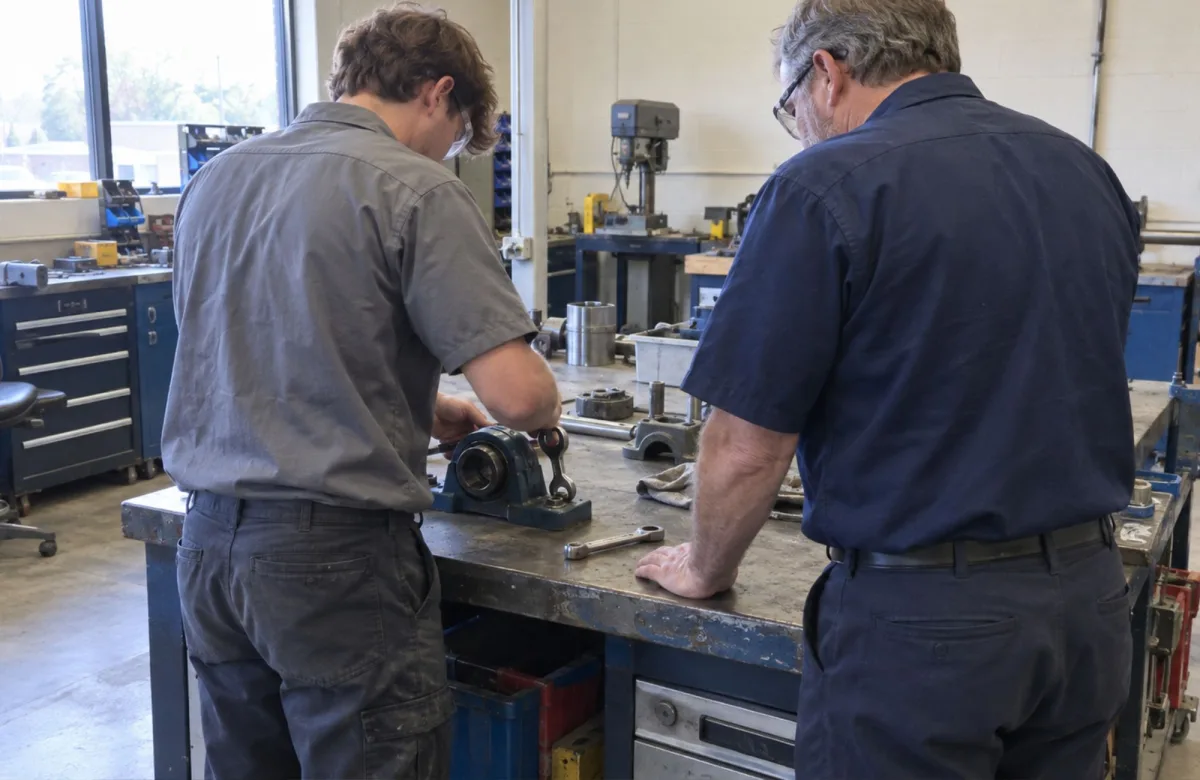
A maintenance apprenticeship combines paid, supervised work with technical instruction to develop technicians who can maintain, repair, and troubleshoot equipment. To build a registered program, your organization must define the occupation, establish training and wage progression, arrange qualified supervision, and secure approval from the appropriate federal or state apprenticeship agency.
For HR Directors and Operations VPs, the starting point is your facility’s maintenance workload, staffing needs, and training capacity. This guide explains how to turn those needs into a structured program. To discuss the technical training component, build your maintenance apprenticeship with ITC.
What Is a Maintenance Apprenticeship?
A maintenance apprenticeship develops occupational skills through planned work assignments, mentoring, and related technical instruction, or RTI. RTI teaches the principles behind the tasks apprentices practice on the job.
An industrial apprenticeship typically focuses on production machinery, mechanical equipment, electrical controls, and fluid power systems. Building maintenance programs may emphasize heating, ventilation, air conditioning, plumbing, and building systems. Choose the occupation that matches the work your technicians actually perform.
The U.S. Department of Labor’s Registered Apprenticeship framework includes paid employment, structured on-the-job learning, mentoring, supplemental education, progressive wages, and a portable, nationally recognized credential. An internal training program does not become registered simply because your company calls participants apprentices.
Within broader workforce development programs, apprenticeship provides a defined pathway from entry-level employment toward occupational proficiency.
How to Build a Registered Maintenance Apprenticeship Program
Use the steps below to build a registered maintenance apprenticeship that aligns job requirements, technical instruction, supervised practice, mentor support, and workforce needs.
1. Define the Occupation and Business Need
Review your maintenance backlog, recurring failures, retirement exposure, and hard-to-fill positions. Identify which capabilities your facility needs to develop internally.
Write an occupational profile that states what a successful graduate must do. For example, your maintenance technician might inspect conveyor drives, interpret electrical schematics, diagnose pneumatic faults, and document repairs in your computerized maintenance management system.
Separate entry requirements from skills the program will teach. Requiring applicants to arrive with advanced troubleshooting experience can exclude the people your apprenticeship should develop. Establish baseline measures, such as time to task qualification and repeat-repair frequency, before the first cohort starts.
2. Choose Your Sponsor and Registration Route
The sponsor administers the apprenticeship and accepts responsibility for its standards. Your organization can explore sponsoring its own program or participating under an existing sponsor, such as an industry association or workforce partnership.
Contact the U.S. Department of Labor’s Office of Apprenticeship or your recognized State Apprenticeship Agency early. Ask which agency has jurisdiction, which occupation fits your needs, and whether an existing work-process outline can support your design.
Prepare to address:
-
Occupational scope and entry qualifications.
-
Work processes and related instruction.
-
Mentor coverage and apprentice-to-journeyworker ratios.
-
Wage progression and performance reviews.
-
Apprenticeship agreements, records, and applicable equal opportunity obligations.
3. Select the Training Structure
Federal apprenticeship standards under 29 CFR 29.5 recognize three approaches:
| Approach | How Apprentices Progress | Planning Consideration |
|---|---|---|
| Time-based | Complete the specified on-the-job learning term | Plan rotations and access to every required work process |
| Competency-based | Demonstrate defined knowledge and skills, with on-the-job learning | Establish consistent practical assessments |
| Hybrid | Meet specified minimum work hours and demonstrate competencies | Track both hours and skill attainment |
Time-based programs typically use 2,000 hours of on-the-job learning as the equivalent of one apprenticeship year, while the approved program standards establish the required term and work processes. Federal regulations recommend at least 144 hours of related instruction for each year of apprenticeship. Your approved standards and applicable state requirements govern the actual program.
Choose the structure with your registration agency. Set a term that covers the occupation rather than promising rapid completion your facility cannot support.
4. Map Technical Instruction to Workplace Tasks
Build a curriculum matrix that connects each work process to instruction, supervised practice, and assessment. This prevents a common problem: apprentices finish courses but rarely practice the corresponding tasks.
The following examples illustrate curriculum planning rather than a complete registered work-process schedule.
| Skill Area | Related Instruction | Supervised Application and Evidence |
|---|---|---|
| Foundations | Technical math, hand tools, measurement, blueprints | Measure components and interpret drawings accurately |
| Mechanical systems | Bearings, lubrication, couplings, pumps | Inspect a drive assembly and explain findings |
| Electrical systems | Circuit theory, motors, schematics | Trace a control circuit on a training setup |
| Fluid power | Hydraulic and pneumatic principles | Interpret a schematic and investigate a controlled fault |
| Controls | Sensors, motor controls, programmable logic controllers | Explain an input/output sequence on training equipment |
| Maintenance practice | Preventive maintenance and fault diagnosis | Complete an assigned work order with supporting evidence |
Add welding, boilers, instrumentation, or HVAC only when the occupation and facility require them. Broad exposure should support a clear occupational outcome.
Use the ITC course catalog for apprenticeships to identify relevant technical content, then map selected courses to your approved RTI plan. ITC’s SCORM-compliant delivery supports assignment and tracking through its platform or your existing learning management system.
Course completion records support learning documentation. Practical demonstrations establish whether apprentices can apply that knowledge. To plan this combination, build your maintenance apprenticeship with ITC.
5. Protect Mentor Time and Establish Safety Boundaries
Choose mentors for technical competence, safe work habits, communication, and willingness to teach. Schedule coaching time and backup coverage so production demands do not repeatedly cancel training.
Give mentors common assessment criteria. For a pump inspection, for example, require apprentices to explain the inspection scope, follow applicable procedures, record observations, and identify when to escalate a finding.
Where applicable, OSHA’s hazardous energy standard, 29 CFR 1910.147, requires an energy-control program and role-specific employee training. Apprentices need instruction tied to the equipment, hazards, and procedures they will encounter.
A course certificate alone does not authorize hazardous work. Define permitted tasks, supervision requirements, and qualification boundaries with your maintenance and EHS leaders before assigning work.
6. Budget for the Full Training Commitment
Your apprenticeship budget must account for more than course fees. Include apprentice wages and benefits, progressive increases, mentor time, instruction, tools, supplies, protective equipment, assessment, administration, and coverage during training.
Assign responsibilities before recruitment:
-
HR: selection, agreements, wage administration, and participant support.
-
Maintenance leadership: rotations, mentors, task access, and practical assessments.
-
Training staff: RTI scheduling, learning records, and remediation.
-
Operations leadership: staffing coverage and protected training time.
Ask your workforce partners about available funding, eligibility, and reimbursement rules. Build a sustainable budget that does not depend on an unconfirmed grant.
7. Recruit a Cohort Your Facility Can Support
Recruit both external applicants and employees who want to move into maintenance. Use consistent, job-related selection criteria and explain the schedule, starting wages, progression, and attendance expectations.
Community colleges, CTE programs, and pre-apprenticeship programs can help prepare a candidate pipeline. Make the transition requirements clear; completing preparation does not automatically guarantee an apprenticeship position.
Size the first cohort around available mentors and work opportunities. Before launch, confirm:
-
Every apprentice has a mentor and a planned rotation.
-
Technical instruction aligns with upcoming work assignments.
-
Payroll can administer the approved wage schedule.
-
Staff can record hours, assessments, and progress reviews.
-
Apprentices know how to request help or report training concerns.
Measure Competency and Operational Results
Review progress at a defined interval, such as monthly during your initial rollout. Track RTI completion, work-process coverage, demonstrated competencies, missed instruction, and overdue assessments.
Connect those measures to operational outcomes carefully. Compare time to qualification, repair rework, retention, and maintenance performance against your baseline. Equipment condition, production volume, and staffing changes also affect downtime, so avoid attributing every improvement to apprenticeship.
Use the records to fix delivery problems. If apprentices pass a hydraulics assessment but cannot interpret a circuit during supervised practice, revise the instruction-to-practice sequence before assigning more coursework.
For Candidates: How to Find and Apply for a Maintenance Apprenticeship
If you want to enter maintenance, search for opportunities under several occupational titles: maintenance technician apprentice, industrial maintenance mechanic apprentice, millwright apprentice, and mechatronics apprentice. Read the duties carefully because similar job titles can involve different equipment and training.
Start with the federal Apprenticeship Job Finder, then check employer career pages, community colleges, and your state’s apprenticeship resources. Confirm the specific program’s registration status with the sponsor or registration agency. An occupation label in a job listing is not enough.
Before applying:
-
Check education, age, assessment, and work-schedule requirements.
-
Prepare a résumé showing relevant coursework, projects, tool use, and employment.
-
Follow the employer’s application process, including any interviews or aptitude assessments.
-
Ask about wages, class schedules, tuition, tools, transportation, and completion requirements.
Compare the full commitment rather than the starting paycheck alone. Ask who provides mentoring and how the program handles missed classes, unsuccessful assessments, or changes in employment.
Why Consider a Maintenance Apprenticeship?
A maintenance apprenticeship can offer a path into skilled work without requiring a traditional four-year degree for every occupation. Apprentices earn wages while gaining supervised experience and technical instruction. Program requirements vary, so check the education and training requirements for the role you want.
The career outlook is also worth considering. According to the U.S. Bureau of Labor Statistics, employment for industrial machinery mechanics, machinery maintenance workers, and millwrights is projected to grow 14% from 2025 to 2035.
Build Your Program Around Demonstrated Capability
A useful maintenance apprenticeship connects a defined occupation, technical education, supervised practice, and consistent assessment. Your priority is a program your facility can deliver reliably, with enough mentor capacity and equipment access to develop each apprentice.
Bring your occupational goals, staffing needs, and existing training resources into the planning discussion. To establish the technical instruction that supports that plan, build your maintenance apprenticeship with ITC.
Why Organizations Choose ITC Learning
ITC Learning provides a technical training foundation for employers and education partners:
-
50+ years developing skilled-trades training
-
1M+ learners trained across technical and industrial skills
-
175+ courses and 450+ lessons covering electrical, mechanical, and other skilled-trades topics
-
SCORM-compliant training that can be delivered through the ITC Learning LMS or an existing learning management system
-
Training available in English and Spanish
-
Training that supports manufacturers, industrial employers, educational institutions, workforce development programs, apprenticeships, and CTE partnerships
Use these resources within a broader apprenticeship plan that includes workplace supervision, practical assessment, and sponsor administration.