
Skills Assessments vs. Certifications: Which Should You Prioritize?
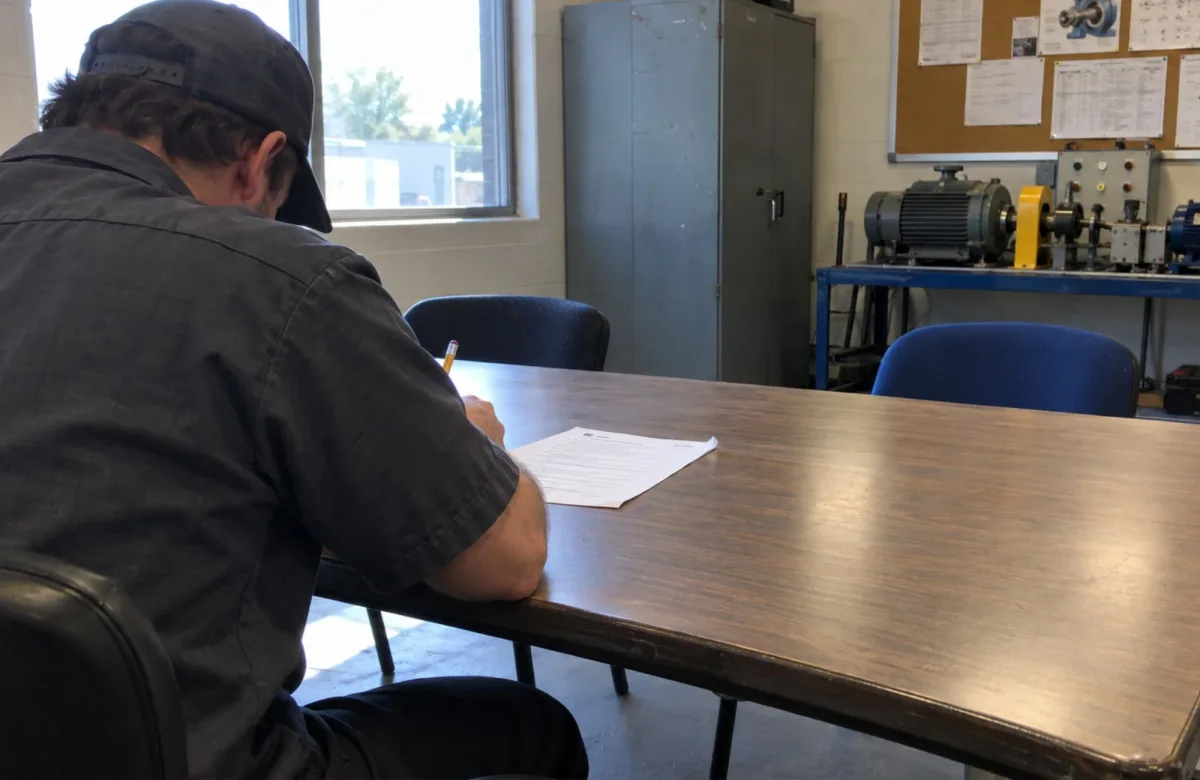
Skills assessments identify workforce strengths and training gaps. Certifications confirm that someone has met a credentialing body’s defined requirements. For most maintenance development programs, prioritize assessment before assigning training or scheduling certification exams. If a role requires a particular credential, plan for that requirement from the start.
For L&D and HR leaders, the decision about skills assessments vs. certifications comes down to purpose: diagnose development needs, then validate achievement. Using both helps your organization connect training investment to the capabilities your facility needs.
Start by identifying those needs. Run a skills assessment for your team.
Skills Assessments vs. Certifications: Key Differences
Skills assessments and professional certifications serve different purposes in maintenance workforce development. An assessment helps you determine what technicians know and where they need development. A certification verifies that someone has met a credentialing body’s requirements within a defined scope.
The distinction matters when deciding where to invest your training budget. An assessment can reveal that a technician needs help interpreting electrical schematics or troubleshooting control circuits. A certification can provide formal recognition of knowledge and competencies covered by a specific credential. One helps you identify development priorities; the other confirms achievement against established requirements.
| Comparison | Skills Assessment | Professional Certification |
|---|---|---|
| Main purpose | Identify current strengths, knowledge gaps, and development needs | Verify that a candidate meets the credentialing body’s requirements |
| Scope | Selected technical knowledge areas relevant to a role or training objective | The knowledge and competencies defined by the certification program |
| Typical result | Scores, knowledge-gap results, and targeted training recommendations | A professional credential after all required criteria are met |
| When to use it | Before training, during cross-training, or to monitor skill development | When a role, career goal, or professional standard calls for a recognized credential |
| What it tells you | Which skills need improvement or further verification | Whether someone has met the requirements for that credential |
| Key limitation | Results reflect only the skills and conditions the assessment measures | The credential does not automatically establish competence in every task or at every facility |
The two approaches can work together. Use assessment results to identify training priorities and prepare technicians for relevant certification exams. After training, reassess the skills that needed improvement and track certification progress separately.
Also, distinguish professional certification from a course completion certificate. The Institute for Credentialing Excellence explains that professional certification differs from assessment-based certificate programs tied to instruction and specific learning outcomes. A course certificate documents a different type of achievement and should not be presented as equivalent to a professional certification.
Which Should Your Organization Prioritize?
Start with the workforce decision you need to make. If you need to identify training needs, begin with a skills assessment. If a role requires a recognized credential, include certification in the development plan from the outset.
Consider a technician who understands motor operation but struggles to interpret control schematics. An assessment can pinpoint the knowledge gap so you can assign relevant instruction and supervised practice. If the technician’s role also requires a professional certification, plan for that credential alongside the immediate training need.
Required workplace training remains separate from both. Under OSHA’s lockout/tagout standard, 29 CFR 1910.147, employers must provide energy-control training appropriate to employees’ assigned duties and certify that the training has been completed. An industry certification does not replace this employer responsibility.
How to Use Both in a Workforce Development Program
1. Establish Role-Based Benchmarks
Define what successful performance looks like before testing your maintenance team. Identify critical tasks, required foundational knowledge, and the evidence needed to demonstrate proficiency. An instrumentation technician’s benchmark might include interpreting loop diagrams and following calibration procedures.
Another role may require mechanical alignment or electrical troubleshooting. Use consistent scoring criteria for comparable roles. Review how to benchmark your maintenance team’s skills to organize the baseline.
2. Identify and Prioritize Skills Gaps
Compare assessment findings with role requirements. Examine results by topic and task rather than relying only on an overall score. Give priority to gaps affecting safety, critical equipment, and shift coverage.
Also investigate whether poor performance stems from missing tools, unclear procedures, or limited practice opportunities. Training addresses learning needs; other causes require operational changes. Use the skills gap analysis playbook to turn findings into development priorities.
To establish a baseline for those decisions, run a skills assessment for your team.
3. Map Findings to Training and Practice
Match each gap to a learning objective, relevant instruction, and supervised application. For the schematic-reading example, assign electrical print-reading instruction, then use an approved training circuit to practice tracing control conditions. Have an evaluator document performance against a task checklist.
The ITC course catalog helps organizations identify relevant electrical, mechanical, and instrumentation instruction. Its SCORM-compliant courses can support delivery through an existing learning management system, keeping structured learning within your organization’s training process.
4. Set a Certification Timeline
Choose certifications that match the responsibilities your workforce needs to perform. Review the issuer’s examination outline, eligibility rules, assessment methods, fees, and renewal requirements.
A certification may cover broad knowledge areas across maintenance and reliability, while a skills assessment can focus on specific competencies relevant to a technician’s role. Use assessment results to identify training needs, then plan certification around the knowledge and qualifications required for the job.
5. Verify Learning and Workplace Results
Reassess relevant knowledge after instruction, then observe practical performance under controlled conditions. Record remaining coaching needs and task approvals separately from certification status.
Track measures such as time to independent performance, repeat maintenance work, and troubleshooting accuracy. Compare results with the starting baseline while accounting for equipment and process changes. Certification pass rates show credential achievement; operational measures help evaluate the training program’s workplace value.
What Individual Technicians Should Prioritize
If you are developing your technical career, start with the skills needed for your target role. Use assessment feedback to choose focused learning experiences and supervised practice.
Before paying for a certification exam, check whether employers in your field recognize the credential and whether its scope fits your career goals. Review prerequisites and renewal obligations. Combine professional credentials with practical experience and clear examples of work you can perform safely.
Build Your Training Plan Around Verified Needs
Assessments help your organization direct training resources. Certifications provide a defined validation milestone. Connect both through relevant instruction, supervised practice, and documented performance. To identify your workforce’s starting point, run a skills assessment for your team.
Why Organizations Choose ITC Learning
ITC Learning supports workforce development with:
-
50+ years developing skilled-trades training.
-
1M+ learners trained across technical and industrial skills.
-
175+ courses and 450+ lessons covering electrical, mechanical, and other skilled-trades subjects.
-
SCORM-compliant training delivered through the ITC Learning LMS or an existing compatible learning management system.
-
Training available in English and Spanish.
-
Support for manufacturers, industrial employers, educational institutions, workforce development programs, apprenticeships, and Career and Technical Education (CTE) partnerships.